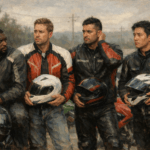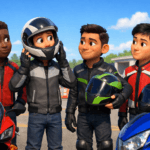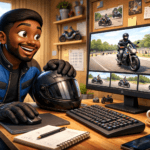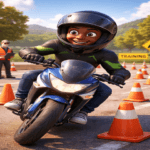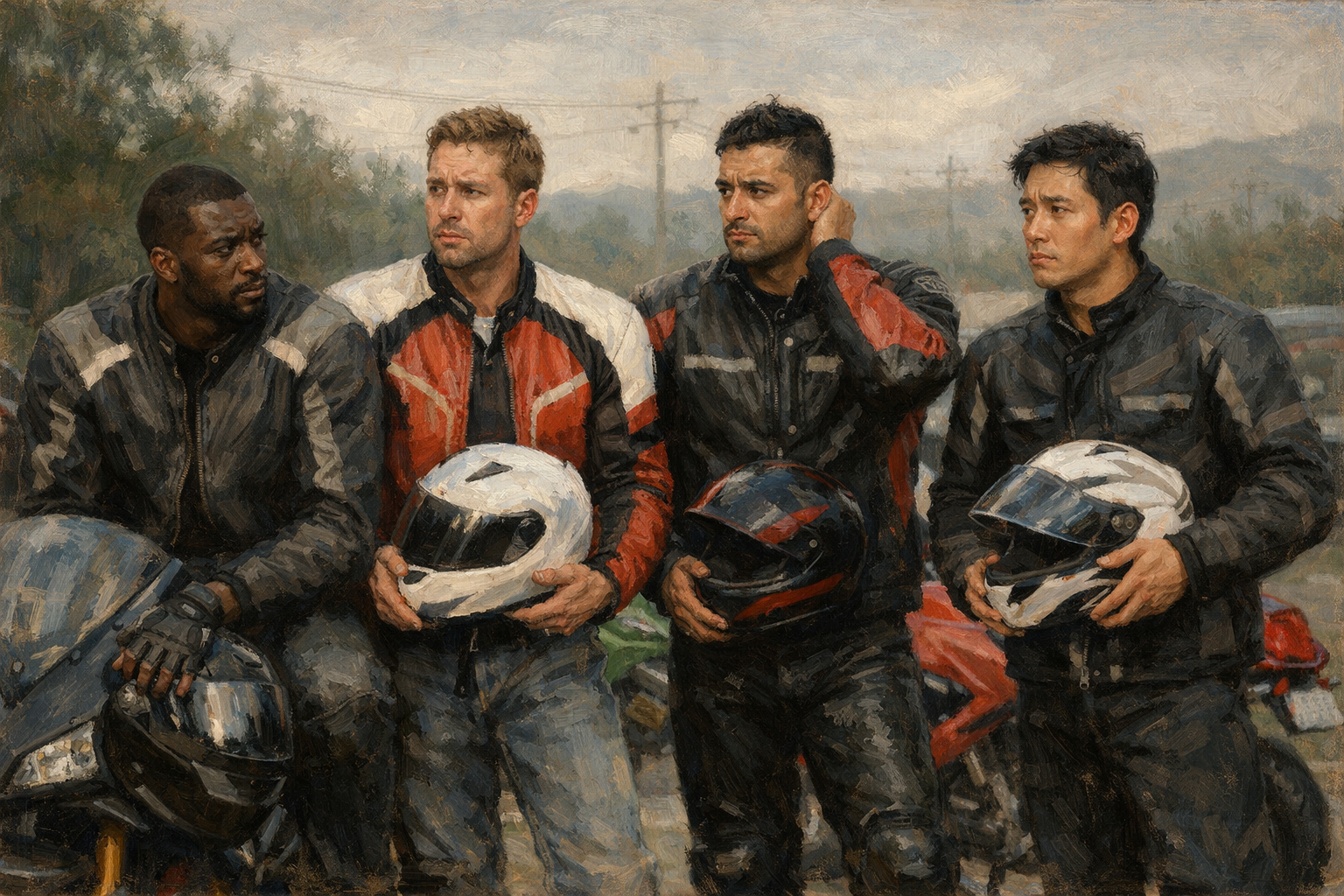
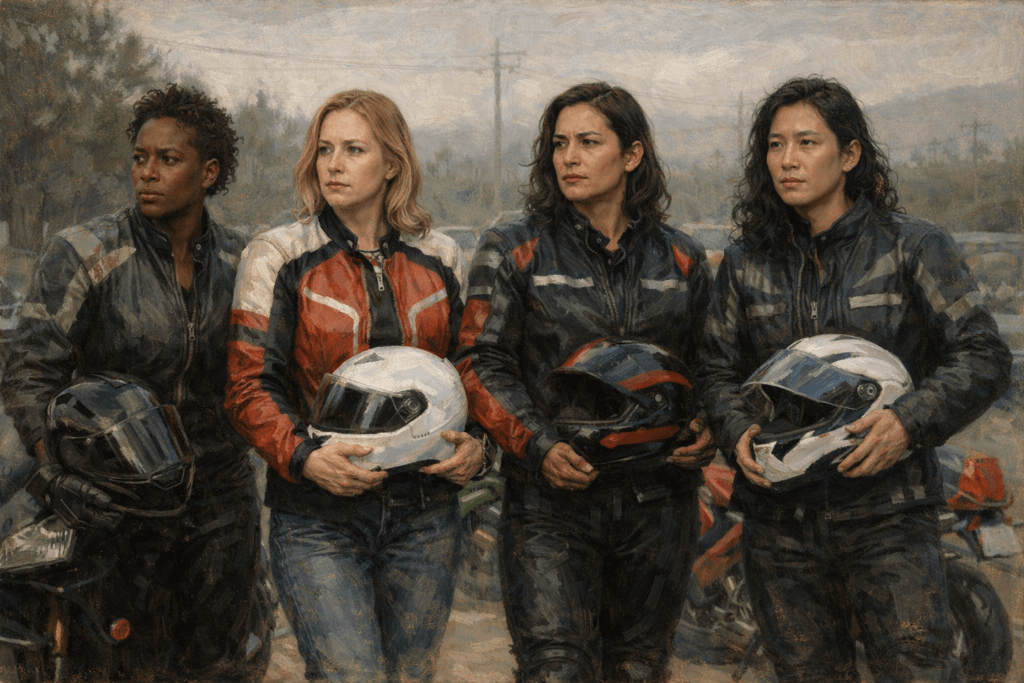
There is a moment almost every beginner rider experiences, and it usually happens before the motorcycle even moves. You walk toward the bike, helmet in hand, trying to look composed, and suddenly your brain turns into an unpaid drama writer. What if I stall? What if I drop the bike? What if I forget everything the second I start rolling? By the time you actually sit down, your heart is beating like you already entered a race you never agreed to join.
That nervous feeling can be so strong that many new riders assume something must be wrong with them. They think maybe they are not built for this, not brave enough, not calm enough, not naturally “motorcycle material.” That idea sounds convincing in the moment, but it is nonsense. Nervousness before your first ride is not proof that you should quit. It is proof that your brain understands you are about to do something new, physical, and important.
Most people get this part backward. They think confidence comes first, then action follows. In reality, action usually comes first, and confidence shows up later like a late guest pretending it was always invited. That is why beginners often feel confused. They are waiting to feel ready, while real progress begins when you learn how to move forward even while feeling a little unsure.
The Problem Is Not Nervousness
The biggest mistake beginners make is treating nervousness like an enemy. They think the goal is to eliminate fear, crush anxiety, and transform into some cool, silent action hero who stares at the horizon and never blinks. That image may look good in movies, but it is not how skill works in real life. Real riders do not become good because they stopped feeling anything. They become good because they learned how to function well even when their nerves showed up.
That distinction matters. Nervousness is not automatically a warning that you are incapable. Sometimes it is just your body reacting to uncertainty. Riding a motorcycle is not like sitting on a couch and deciding between two snack options. It requires balance, coordination, attention, and judgment. Your body notices that right away, even if your conscious mind is trying to act casual.
In fact, a beginner who feels some nervousness is often in a better position than a beginner who feels none at all. Nervous riders tend to pay attention. They listen more carefully, respect instructions, and approach the machine with healthy caution. The person who acts wildly confident on day one is sometimes the one most likely to skip the basics and learn lessons the hard way.
Your Brain Thinks It Is Protecting You
The brain loves certainty. It likes familiar patterns, predictable environments, and routines that do not require much negotiation. A first motorcycle ride offers none of that. You are dealing with a machine you do not yet fully understand, a body position that feels unusual, and a skill set that combines several actions at once. To your brain, this feels less like “fun new hobby” and more like “possible danger, please investigate.”
That is why your body reacts the way it does. Your shoulders tighten. Your breathing gets shallow. Your thoughts speed up. You become hyper-aware of everything, including things that normally would not bother you, like how weird your gloves feel or whether everyone nearby can hear your internal panic speech. None of this means you are weak. It means your nervous system is doing what nervous systems do when faced with uncertainty.
The frustrating part is that your brain does not always know the difference between actual danger and unfamiliar challenge. It often treats both the same at first. That is why a training course in a controlled parking lot can still make you feel like you are preparing for a moon landing. Your brain hears “motorcycle” and starts acting like you applied for combat.
The Real Fear Is Often Social
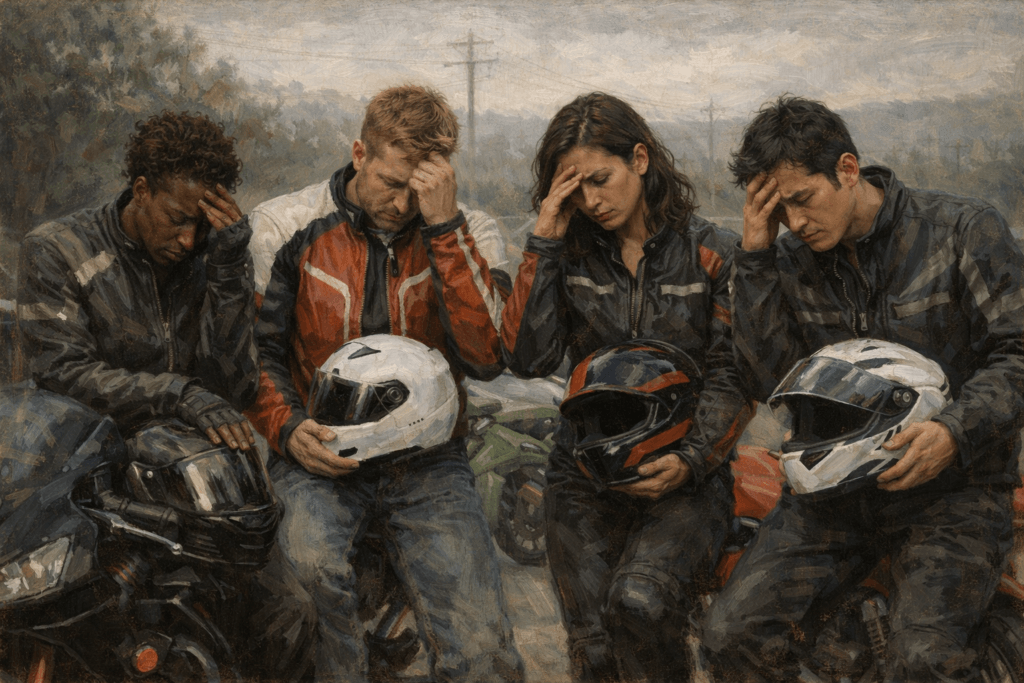
A lot of beginners think they are afraid of the motorcycle itself, and part of that is true. But there is usually another layer underneath it, and that layer is embarrassment. People worry about stalling in front of others, wobbling during practice, or looking clumsy in front of an instructor. They are not just afraid of making mistakes. They are afraid of being seen making mistakes.
That social fear is powerful because it hits pride. Many adults are comfortable being beginners in private but hate being beginners in public. On a motorcycle, there is no hiding the learning curve. If the bike stalls, it stalls. If your start is jerky, it is jerky. If you forgot the sequence, the machine will not politely cover for you out of respect for your feelings.
The funny part is that nearly everyone around you is too busy worrying about their own performance to spend much time judging yours. The other beginner next to you is not building a detailed report about your riding flaws. They are wondering whether they are about to forget how to use the clutch again. The instructor has seen every form of beginner awkwardness imaginable, usually before breakfast. What feels humiliating to you often looks completely ordinary to everyone else.
Why the First Ride Feels Mentally Heavy
Your first ride can feel overwhelming because it demands more mental coordination than beginners expect. You are not just sitting on a machine and going forward. You are managing balance, throttle, braking, steering, body position, scanning, and self-control all at once. That is a lot for a brain that has not built the pattern yet.
When the brain handles too many new inputs at once, it often interprets overload as danger. That is one reason beginners can freeze or overthink simple actions. They are not dumb. Their mental bandwidth is crowded. Every small step feels larger because nothing is automatic yet.
Experienced riders forget this because so much of riding becomes second nature over time. They no longer think carefully about every control input. Beginners do. They are mentally translating every movement in real time, which makes the whole process feel heavier than it will later. What feels chaotic in the beginning often becomes smooth once your brain has enough repetition to stop treating each action like a separate emergency.
Confidence Is Not a Personality Type
One of the worst myths in riding is the idea that confidence belongs to certain kinds of people. The loud ones. The naturally bold ones. The people who never seem rattled. That story sounds neat, but it falls apart in real life. Confidence is not a personality gift handed out at birth. It is a learned response built through evidence.
That is important because it means you do not have to wait to become a different kind of person before you can ride well. You do not need a new personality. You need proof. Every time you start smoothly, brake under control, complete a clean turn, or recover from a mistake, your brain collects evidence. That evidence becomes trust, and that trust becomes confidence.
This is why trying to “feel confident” before you have enough experience often fails. Your brain is not moved by motivational speeches alone. It wants receipts. It wants to know that you have done hard things before and survived them. Confidence grows when your body and brain can honestly say, “We have handled this before, and we can handle it again.”
Stop Asking for Instant Calm
Beginners often ask how to calm down before a first ride, and that is fair. But sometimes the better goal is not total calm. Sometimes the better goal is usable calm. You do not need to feel like you are at a spa getting a hot stone massage while soft flute music plays in the background. You just need to be settled enough to pay attention and respond well.
That shift matters because unrealistic expectations create extra pressure. If you believe you should feel completely relaxed, then any nervousness will feel like failure. But if you expect some nerves and plan to ride well anyway, then the feeling loses much of its power. It becomes background noise instead of a full-blown headline.
A lot of early confidence comes from accepting the feeling rather than wrestling with it. You can say, “Yes, I’m nervous, and I’m still going to focus on the next step.” That mindset is stronger than pretending fear does not exist. It is honest, practical, and far more useful than fake bravado.
What Actually Helps Before You Ride
Preparation helps more than hype. Simple things matter. Arriving early gives your mind time to settle instead of rushing in with your nerves already halfway to the ceiling. Watching the training area, hearing instructions clearly, and getting physically comfortable with your gear can make the environment feel less foreign. Familiarity calms the brain because it reduces the number of unknowns.
It also helps to narrow your attention. Beginners get into trouble when they try to mentally master the entire art of riding before the first roll of the wheels. That is too much. Focus on the next task, not the whole future. Smooth start. Controlled stop. Easy turn. The ride becomes much less intimidating when it is broken into pieces your brain can actually handle.
Breathing also matters more than people think. Nervous riders often hold tension in their shoulders, arms, and hands, which makes the bike feel harder to control. The irony is brutal. The more scared you feel, the stiffer you get, and the stiffer you get, the worse everything feels. Relaxing your upper body, breathing slowly, and loosening your grip can make an immediate difference. The motorcycle wants clear inputs, not a death grip and a prayer.
Your First Ride Is Not Your Final Identity
A bad first ride does not mean you are a bad rider. A shaky start does not predict your long-term ceiling. Stalling, wobbling, or feeling clumsy are not character flaws. They are ordinary signs that you are new. The danger comes when beginners turn a moment into an identity. They go from “I made a mistake” to “I’m not cut out for this” in about three seconds flat.
That jump is unfair and usually false. Learning is messy. Riding is no exception. Some people look smoother early because they have prior experience with manual vehicles, bicycles, or other physical skills. Others need more repetition before the pieces click. Neither path tells the whole story.
Many excellent riders had rough starts. They just kept showing up. They did not build confidence by having a perfect first day. They built confidence by refusing to turn beginner moments into permanent labels. That is the real mental shift. You stop asking whether you are naturally good and start asking whether you are willing to practice honestly.

The Identity Shift Begins Earlier Than You Think
A lot of beginners assume they become “real riders” only after passing a test, buying a bike, or logging a certain number of miles. But the identity shift usually begins earlier. It starts the moment you decide to learn with seriousness. It starts when you respect the process enough to be taught, corrected, and improved. That is not small. That is the foundation.
You do not become a rider because you looked cool for five seconds in a parking lot. You become a rider because you are willing to build skill with patience. You become a rider when you stop treating confidence like a personality trait and start treating it like a practice. That mindset is quieter than swagger, but it is far more durable.
So why are you so nervous before your first ride? Because you are human, because your brain likes certainty, and because learning something real will always shake you a little at the start. That is not a sign to run. It is a sign that you are standing at the beginning of something that matters.
And that beginning is supposed to feel a little shaky.
Good.
That means it is real.
Final Thought
Riding is supposed to make your life bigger, not shorter.
If something in this post made you think twice, good. That pause is where better decisions live.
Stick around.
Read more.
Learn from stories that weren’t free to earn.
Because the goal isn’t to ride harder.
It’s to ride longer.
— The Squirrelly Biker